Thursday, January 2, 2025

MongoDB Database Structure


MongoDB Database Structure

MongoDB, a popular NoSQL database, utilizes a flexible document-based structure to store data. Here's a breakdown of its key components:

1. Databases:

  • A logical container for a set of collections.
  • You can have multiple databases within a single MongoDB instance.
  • Databases are typically named to reflect their purpose (e.g., "customer_db", "product_db").

2. Collections:

  • Analogous to tables in relational databases.
  • Store a set of documents.
  • Can contain documents with varying structures within the same collection.

3. Documents:

  • The fundamental unit of data storage in MongoDB.
  • Similar to JSON objects, they consist of key-value pairs.
  • Keys are strings, and values can be of various data types:
    • Strings
    • Numbers (integers, decimals)
    • Booleans
    • Arrays
    • Embedded documents (objects within a document)
    • Dates
    • Binary data


Many of the components that go into the MongoDB data structure have their counterparts in relational database management systems based on the Structured Query Language (SQL).


Example:

JSON

{

  "_id": ObjectId("5f49c3d27007234567890abc"), // Unique identifier

  "name": "John Doe",

  "age": 30,

  "address": {

    "street": "123 Main St",

    "city": "Anytown",

    "state": "CA"

  },

  "hobbies": ["reading", "hiking", "coding"]

}


The document, which is comprised of field/value pairs, is at the heart of the MongoDB data structure. Most interactions with MongoDB occur at the document level.

field can contain a single value, multiple fields, or multiple elements.
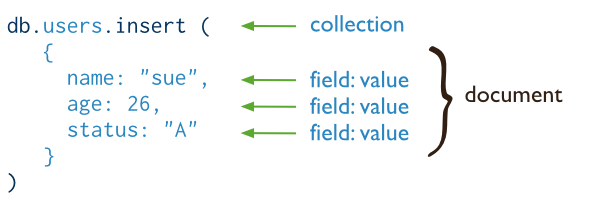

 A value made up of multiple fields is referred to as an embedded document and is assigned the Object data type (see field cars in the screenshot). When rendered in the JSON format, an embedded document is enclosed in curly braces and adheres to the same structure as the outer (main) document.


 MongoDB Data Types

A field can be one of these MongoDB data types:

Type

Alias

Double

“double”

String

“string”

Object

“object”

Array

“array”

Binary data

“binData”

Undefined

“undefined”

ObjectId

“objectId”

Boolean

“bool”

Date

“date”

Null

“null”

Regular Expression

“regex”

DBPointer

“dbPointer”

JavaScript

“javascript”

Symbol

“symbol”

JavaScript (with scope)

“javascriptWithScope”

32-bit integer

“int”

Timestamp

“timestamp”

64-bit integer

“long”

Decimal128

“decimal”

Min key

“minKey”

Max key

“maxKey”

Key Characteristics:

  • Schema-less: You don't need to define a strict schema upfront. Documents within a collection can have different fields.
  • Dynamic: The structure of documents can evolve over time as your application needs change.
  • Flexible: Handles complex data structures easily due to the use of embedded documents and arrays.

Visual Representation:


MongoDB database structure with databases, collections, and documents

By understanding this structure, you can effectively model and store your data in MongoDB, leveraging its flexibility and scalability for various applications.

Code to connect MongoDB to Python and create a database and a collection in MongoDB

import pymongo # Replace the connection string with your MongoDB connection string mongo_uri = "mongodb://username:password@localhost:27017/mydatabase" # Connect to MongoDB client = pymongo.MongoClient(mongo_uri) # Create or access a database db = client.get_database("mydatabase") # Create or access a collection collection = db.get_collection("mycollection") # Insert a document into the collection data_to_insert = { "name": "John Doe", "email": "john@example.com", "age": 30 } inserted_doc = collection.insert_one(data_to_insert) print(f"Inserted document ID: {inserted_doc.inserted_id}") # Close the MongoDB connection (optional, but recommended) client.close()


Query the MongoDB database using the find() method

import pymongo # Replace the connection string with your MongoDB connection string mongo_uri = "mongodb://username:password@localhost:27017/mydatabase" # Connect to MongoDB client = pymongo.MongoClient(mongo_uri) # Access the database and collection db = client.get_database("mydatabase") collection = db.get_collection("mycollection") # Define a query filter query_filter = {"age": {"$gte": 30}} # Use the find() method with the query filter cursor = collection.find(query_filter) # Iterate through the results and print them print("Documents with age greater than or equal to 30:") for document in cursor: print(document) # Close the MongoDB connection (optional, but recommended) client.close()

Labels: , , , , ,


NoSQL Database :

NoSQL databases, short for "Not Only SQL," are a broad category of database management systems that go beyond the traditional table-based relational model. They offer flexible data models and are designed to handle large volumes of unstructured and semi-structured data.  NoSQL databases are designed to handle high volumes of data that don’t fit neatly into traditional database schemas. They’re perfect for applications that require rapid development, scalability, and the ability to store unstructured data.

Key Characteristics:

  • Flexible Data Models: NoSQL databases support various data models, including:
    • Key-value: Store data as key-value pairs (e.g., Redis, Memcached)  
    • Document: Store data in flexible documents (e.g., JSON, XML) (e.g., MongoDB, Couchbase)  
    • Column-family: Organize data into columns (e.g., Cassandra, HBase)  
    • Graph: Represent data as nodes and relationships (e.g., Neo4j)  


  • Scalability: NoSQL databases are designed to scale horizontally, meaning you can easily add more servers to handle increasing data volumes and user traffic.  
  • High Availability: Many NoSQL databases offer high availability features, ensuring that your data is always accessible even in case of server failures.  

Advantages of NoSQL Databases:

  • Scalability and Performance: NoSQL databases are well-suited for handling massive datasets and high-traffic applications, providing excellent performance for read and write operations.  
  • Flexibility: The flexible data models of NoSQL databases make them adaptable to evolving data structures and requirements.  
  • Cost-Effectiveness: NoSQL databases can be more cost-effective than traditional relational databases, especially for large-scale deployments.  
  • Ease of Development: The flexible schema and object-oriented nature of some NoSQL databases can simplify development and reduce time to market.  

Common Use Cases:

  • Content Management Systems: Handling large volumes of unstructured content like images, videos, and text.  
  • Social Media Platforms: Storing user profiles, posts, comments, and relationships.  
  • E-commerce: Managing product catalogs, user data, and transaction histories.  
  • Internet of Things (IoT): Processing and storing sensor data from connected devices.  
  • Real-time Analytics: Analyzing large streams of data for insights and decision-making.  

Popular NoSQL Databases:

  • MongoDB: A popular document database that stores data in flexible JSON-like documents.  
  • Cassandra: A highly scalable and distributed database designed for handling large amounts of data.  
  • Redis: An in-memory data store often used as a cache or message broker.  
Neo4j: A graph database that specializes in storing and querying data with complex relationships.

Key-Value Stores at Heart

At their core, many NoSQL databases function as key-value stores. Each data item is stored as a key-value pair, where the key serves as a unique identifier and the value holds the data, potentially structured as a JSON document. This simple yet effective structure facilitates rapid, straightforward data retrieval without the need for complex joins or transactions.


SQL vs NoSQL

SQL

NoSQL

Strengths

·         Relational: SQL databases are relational, allowing easy querying across multiple tables. This is crucial for organizing and structuring diverse data efficiently.

·         Structured Data: The requirement for a predefined data model reduces potential errors, ensuring data integrity.

·       ACID Compliance : Ensuring transactions are atomic, consistent, isolated, and durable, SQL databases guarantee that transactions are executed entirely or not at all, enhancing data reliability.

·         Flexibility: NoSQL databases are easier to set up and are better suited for unstructured data, thanks to their lack of table relationships.

·         Horizontal Scaling: They are designed for easy sharding across distributed systems, allowing for efficient large-scale data storage without hefty server costs.

Weaknesses

·         Setup Time: The need for pre-defined columns and tables means SQL databases take longer to set up and are less suitable for unstructured data.

·         Scaling: Horizontal scaling is challenging due to the relational structure, making vertical scaling (which is often costlier) the primary option for write-heavy systems.

·         Eventual Consistency: In distributed setups, updates might not propagate immediately, leading to potential access to stale data. This is a trade-off for scalability.

·         Strong Consistency vs. Scalability: While a single-shard NoSQL database can offer strong consistency, exploiting the scalability benefits fully requires a distributed cluster setup.


Architecture with NoSQL

In order to understand how to properly architect applications with NoSQL databases you must understand the separation of concerns between data management and data storage. The past era of SQL based databases attempted to satisfy both concerns with databases. This is very difficult, and inevitably applications would take on part of the task of data management, providing certain validation tasks and adding modeling logic. One of the key concepts of the NoSQL movement is to have DBs focus on the task of high-performance scalable data storage, and provide low-level access to a data management layer in a way that allows data management tasks to be conveniently written in the programming language of choice rather than having data management logic spread across Turing-complete application languages, SQL, and sometimes even DB-specific stored procedure languages.


Labels: , , , , , , ,